The Milwaukee Clipper is a much storied ship and one that has been extremely fortunate to have survived not just the vagaries of nature but the fickle dealings of industry.
At first glance this ship may appear to be a survivor from the 1930s but in fact, the Milwaukee Clipper is only 106 years young.


In 1940, after four years of layup, the Juniata was bought by the Wisconsin & Michigan Stamship Company and was completely rebuilt. She emerged as the distinctly modern and unique Milwaukee Clipper, she was the only one of the sisters to eventually return to commercial service.

The original builders plate for the Juniata now resides in the ship's museum.
The Juniata could have easily been scrapped but instead she was rebuilt into a unique ship that symbolised the new expression of artistic modernism which was replicated across several of the newest American ocean liners of that era. The old look was replaced by a racy, modern and streamlined exterior that made the ship completely unrecognisable as her former self and gave her a style that was unique to passenger shipping on the Great Lakes. The only other passenger ship on the Great Lakes that came close to this degree of exterior styling was the Aquarama which entered service in 1952. Some brochure views: http://www.timetableimages.com/maritime/images/moncsp.htm
And here: http://www.timetableimages.com/maritime/images/moncbr.htm
American ocean liners embraced this style from the 1930s through to the 1950s with such examples as the Del trio (photos of the Del-Ships: http://www.ssmaritime.com/Del-Trio.htm) and the Ancon trio (photos can be seen here: http://www.angelfire.com/tx/CZAngelsSpace/PRRLinersOne.html). This streamlined styling climaxed with the 1958 Moore-McCormack sisters. (photos here: http://www.moore-mccormack.com/SS-Brasil-1958/SS-Brasil-Timeline.htm)
On the Great Lakes only a handful of ships sported a streamlined exterior and even fewer were passenger ships, today there is only the Puget Sound ferry Kalakala and the Milwaukee Clipper left to remind us of an era long gone. (For more information about the Kalakala see here: http://www.kalakala.org/). The Aquarama was scrapped in 2007 leaving only the Milwaukee Clipper as the sole survivor of a once considerable class of ship. Not only is she the last surviving American built art deco passenger ship on the Great Lakes, but she is also over a century old and still has her original quadruple expansion engines. She is also in remarkably good condition - a state of being that some ships many decades her junior would be envious!
 |
| Milwaukee Clipper at her current home in Muskegon, Michigan. |
A tour of the Milwaukee Clipper provides an insight into a time when travelling included a touch of elegance and an opportunity to enjoy the good company of family and friends.

This is a slightly modified photo of the Milwaukee Clipper arriving at her namesake city, the original (and larger) photo can be found here: http://www.retrocom.com/retromilw/clipper1.htm

 |
| Upon entering through the main doors, passengers were treated to this friendly message. |
Below are photos depicting cabins in various states of preservation:
 |
| This cabin is patiently awaiting some TLC.... |
 |
| The restoration of this cabin has brought it back to it's early Clipper condition. |
 |
| On the upper deck forward of midships is the ship's Theatre complete with original fold up chairs. |
 |
| Immediately ahead of the Theatre is the Children's Playroom, the two rooms were separated by a distinctly non-sound proof curtain. The two fairytale characters outlined to the right of the picture are original to the Milwaukee Clipper. Elmer Fudd and Bugs Bunny were added during the ships time in Chicago. |
 |
| The Grand Staircase reflects the clean aesthetics of Art Deco styling and functionality. A glimpse into what the staircase well would have looked like when the ship operated as the Juniata can be found aboard the Keewatin (see below). |

 |
| The Keewatin was built in 1907 and currently resides at Douglas, Michigan and is open for visitors. More information can be found here: http://en.wikipedia.org/wiki/SS_Keewatin |
 |
| Another remnant from the Juniata that can still be seen are the sounding ports, these plugs, once opened, allow a measuring pole to be inserted to determine the depth of water in the bilges. |
Continuing our tour of the Milwaukee Clipper:
 |
| The Soda Bowl. |
The attendant behind the counter came to be known as the 'Soda Jerk', this term came from the old soda fountain days. The kids behind the counter would be serving "SODA
or POP" and would have to "JERK" the handle to get it to pour from the tap

 |
| The beautifully restored 1940s bar displaying what 20,000 hours of preservation work will do. |
 |
| A quiet corner at the cafeteria. |


For more period views see these Brochure images: http://www.timetableimages.com/maritime/images/wmsc.htm
And here for more internal views: http://www.timetableimages.com/maritime/images/wmsc54i.htm
 |
| A lounge area for quiet reflection. |
 |
| The ships bridge is a mixture of period equipment and replicas which have replaced the originals lost to vandals while the ship spent years laid up in Chicago. |
 |
| The ship's wheel. |
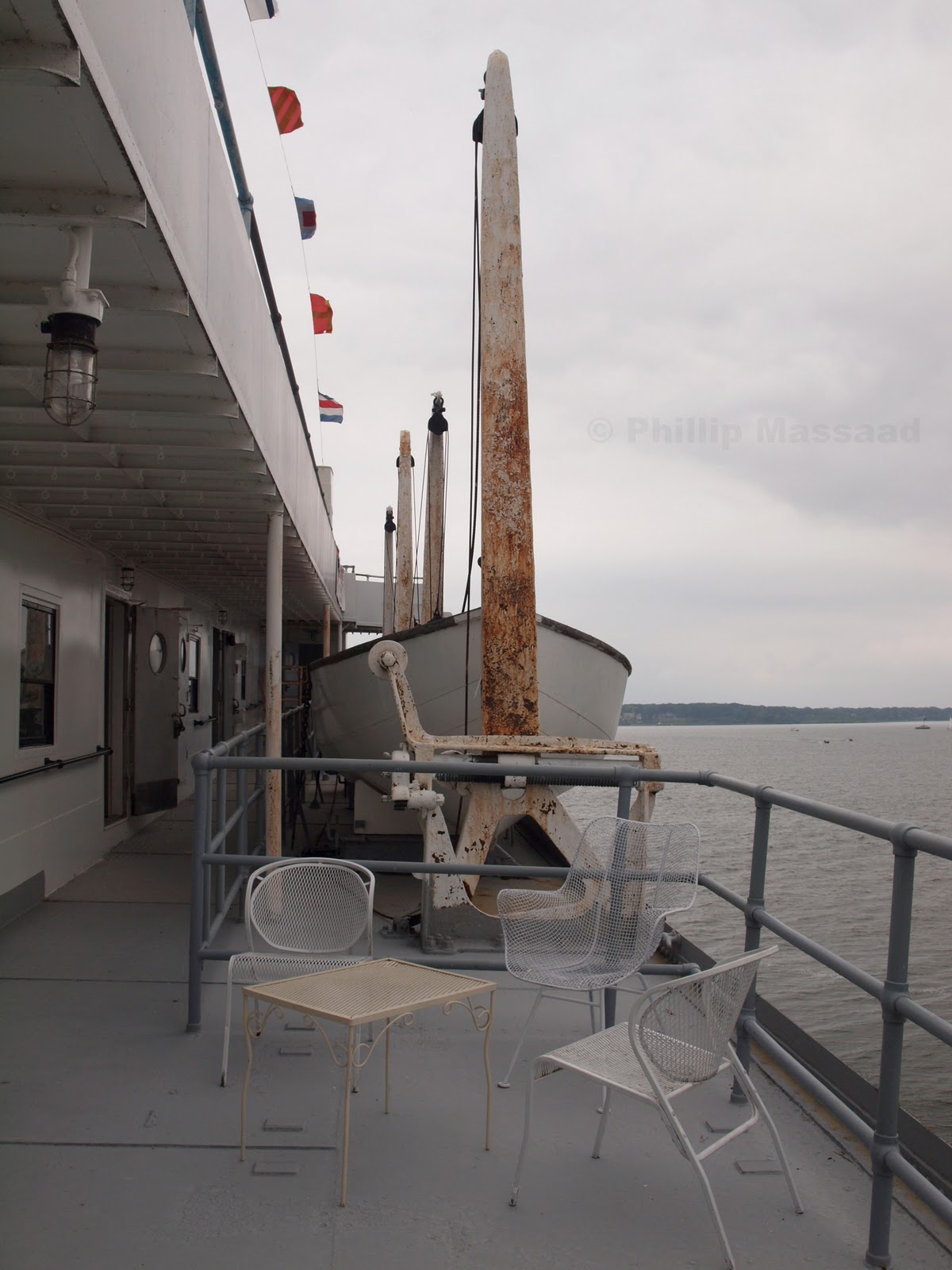 |
| During her years of service, the lifeboats were rarely used although there were two occasions where they were deployed. One time involved rescuing the dog of Mr McKee, a prominent businessman and owner (at the time) of the Milwaukee Clipper, which decided to go for a swim and jumped out of his cabin porthole. The other occasion was when a woman tried to end her life by jumping overboard however she was rescued before the lake claimed her. |
 |
| Looking towards the forepeak. |
 |
| The streamlined forward superstructure of the Milwaukee Clipper typifies the era of elegance and functionality of the mid thirties. |
 |
| Glancing back on the upper deck looking towards the faux funnel installed during the rebuild. While not a functional funnel, this structure was used to house generators, ventilation fans and batteries. |
 |
| The 'real' funnel of the Milwaukee Clipper and to the left can be seen the original whistle used when the ship operated as the Juniata. |
 |
| The Juniata original quadruple expansion engine was retained during the rebuild and is currently the only remaining American built engine of this type still in existence. The engine remains in extremely good condition however the four Scotch boilers have not aged as well and will need to be completely rebuilt before this engine can run again. |
 |
| Also original from the days of the Juniata is the large rudder mechanism. The white chains at the top of the photo are the back-up should the main rudder engine fail. |

The dominant feature of the museum is the large half model of the Milwaukee Clipper.

The story of how this model came to be is recounted here: The builder was Lester Williams, a graduate of Ripon College in Wisconsin, majoring in Physics and Math. He became a sign painter in Green Lake, Wis. He built two half models, the SS Amsterdam and the SS Milwaukee Clipper. Lester built the Clipper model while the SS Juniata was undergoing her rebuild into the Milwaukee Clipper in 1940, supposedly on the advice from someone working on the ship as to what she would look like. He gave the model to the owner of the Nautical Inn in Green Lake and apparently took the value out in drinks. This would account for the little discrepancies the model has. In 1947 the owner in the Inn converted it into a dairy bar and the model was no longer appropriate. It was moved to one of the storage buildings of the Pilgrim Church Camp until it was later hung in the mess hall over the doorway. When they no longer wanted it, they contacted Mr. Jim Landwehr of the Wisconsin Historical Society and he put them in touch with MCPI (Milwaukee Clipper Preservation, Inc.) The camp had no idea that the Clipper still existed. A group of Clipper volunteers went to Wisconsin and brought the model back on a big trailer on the SS Badger. The Badger people got a big kick carrying the Clipper to Michigan!
A traditional steam powered voyage on the SS Badger can still be enjoyed, see here: http://www.ssbadger.com/home.aspx
 |
| This painting of the Milwaukee Clipper arriving on a wintry morning is by local Muskegon artist Bruce DeVries. |
 |
| A last glance at the Milwaukee Clipper, a ship undergoing a steady rebirth after a long hibernation and one that represents two amazing eras of maritime history. Douglas MacArthur said it and I will repeat it here: I shall return! |
The Milwaukee Clipper is slowly being brought back to life by a dedicated group of locals who have formed the S.S. Milwaukee Clipper Preservation Inc, and apart from being among the friendliest and most hospitable people I have ever met, have worked wonders in gradually resurrecting this beautiful ship back to her former glory.

Image courtesy of SS Milwaukee Clipper Preservation Inc.
 |
| This poster comes from the preserved car ferry City of Milwaukee but the messaging applies not just to the Milwaukee Clipper but to all preservationists seeking to educate future generations by preserving the last vestiges of the past. More info on the City of Milwaukee can be found here: http://www.carferry.com/ |
Other helpful links:
http://en.wikipedia.org/wiki/Milwaukee_Clipper
http://www.hnsa.org/ships/clipper.htm


